
An outdoor bar doesn't need much to work. A counter, a couple of stools, and a reason to sit there. But of all the furniture decisions on a patio, bar stools are the ones people make last — usually right after the counter is already built, and usually in a hurry.
That's an unfortunate order of operations, because stool height is one of the few furniture choices that's genuinely hard to fix afterward. Get it wrong and you're not swapping a cushion, you're replacing the stools or living with knees pressed against the underside of your counter every evening. Here's how to get it right the first time.

Start With the Counter, Not the Stool
The stool is a dependent variable. Its only real job is to sit at the right distance below your counter.
That distance is 10 to 12 inches between the top of the seat and the underside of the counter or tabletop. That gap is what gives your legs room to cross or stretch without hitting the frame, and it's the single rule that solves almost every height problem.
So measure in this order:
- Floor to the top of the counter. Straight up to the highest point of your counter, island, or bar ledge.
- Subtract 10 to 12 inches. That's your target seat height. A 36-inch counter calls for a seat around 24 to 26 inches.
- Check the overhang. If your counter has a deep lip, measure to the underside of that overhang instead — that's your real legroom ceiling, and a 2-inch overhang eats into clearance faster than you'd expect.
One thing to be careful about when shopping: always compare seat height, not overall product height. A stool listed as 43.3 inches tall might place you at 29.1 inches — the difference is the backrest. If a listing doesn't state seat height clearly, assume it's the overall height and keep looking.

Bar Height vs Counter Height: Which Do You Have?
There are two standard categories outdoors, and the terms get used loosely enough that it's worth confirming numbers rather than assuming.
| Stool Type | Seat Height | Designed For Surface Height |
|---|---|---|
| Counter stool | 24–27 in | 34–36 in |
| Bar stool | 28–32 in | 40–42 in |
| Extra-tall | 33–36 in | 44–47 in |
The practical version of this: counter tables run about 34–36 inches tall and need a 24–26 inch seat, while bar tables run about 40–42 inches and need a 28–30 inch seat. Mismatch them and the failure is obvious — bar stools at a counter-height surface raise your knees too high and kill leg clearance, while counter stools at a bar-height surface force you to reach up, straining shoulders and wrists.
And yes, cushion thickness counts. A thick cushion adds to your effective seat height, so factor that in before you commit.
Materials That Actually Survive a Patio
Outdoor bar stools take more punishment than almost any other piece on the patio — sun, rain, chlorine splash, sweaty afternoons, and the occasional dragged-across-the-pavers moment. Materials are where that shows up.
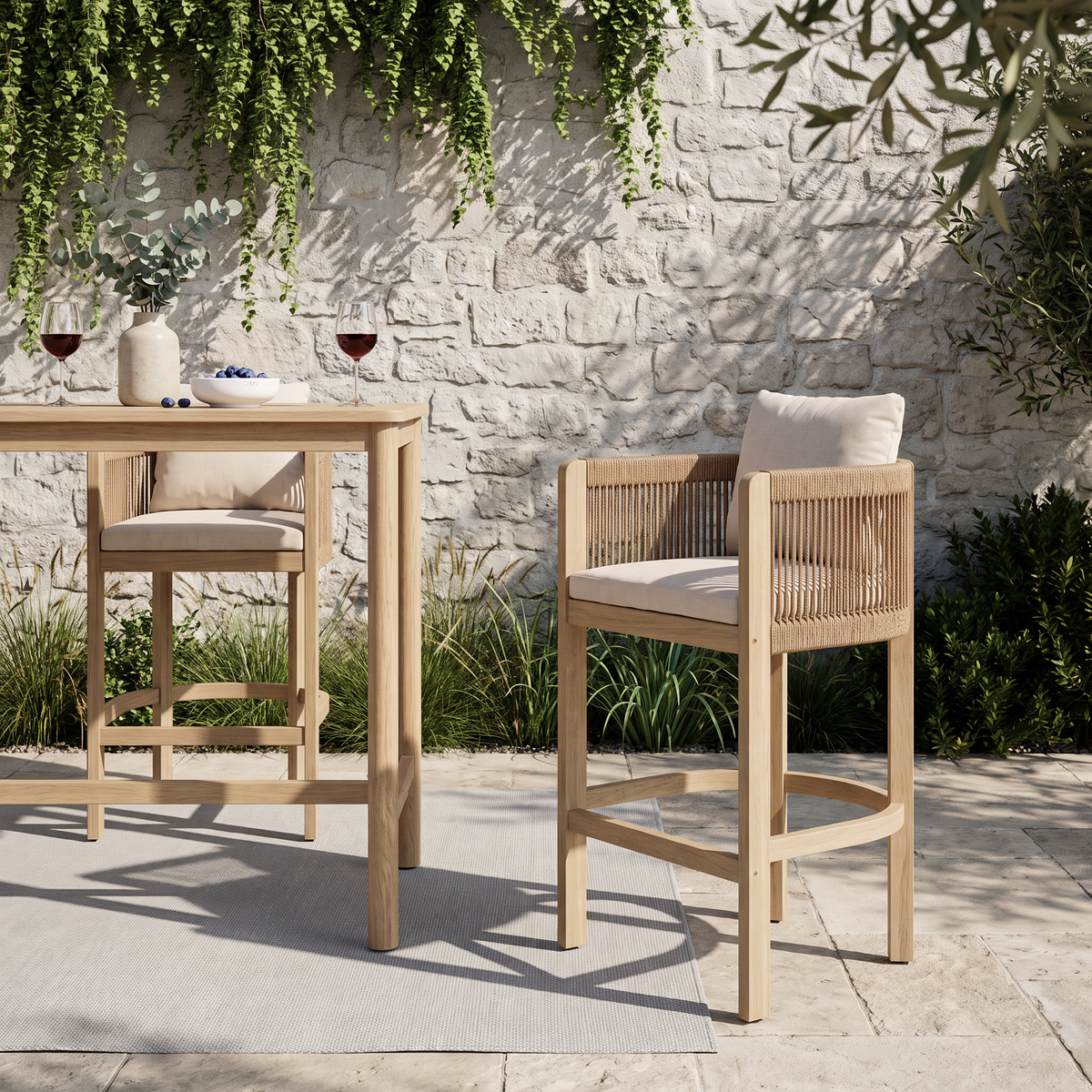
Aluminum frames are the safest bet for weather exposure. They're lightweight, won't rust, and move easily when you want to rearrange. Olefin cushions are a common outdoor pairing for the seat and back. Woven rope detailing gives texture without a maintenance burden. And textured wood finishes read warmer than metal while being more forgiving than solid timber.
For poolside and coastal settings, a few habits stretch the life of any outdoor stool: rinse the frames after heavy pool use to cut chemical residue, use breathable covers off-season, tighten fasteners annually, and rotate the stools periodically for even sun exposure.

How Many Stools Fit Your Bar?
This is more math than most people expect, and cramming in one extra stool is a real regret.
| Measurement | Recommended |
|---|---|
| Elbow room per person | 22 in |
| Space between stools | 6–10 in |
| Center-to-center spacing | 24–26 in |
| Rear aisle clearance | 36 in |
| Seat-to-counter legroom | 10–12 in |
| Footrest height | 7–9 in (counter) / 10–12 in (bar) |
An 8-foot bar comfortably fits four stools at roughly 24 inches center-to-center. Five leads to tight shoulders and bruised elbows. And if your bar is two-tiered — say 36 inches on one side and 42 on the other — you'll need both counter-height and bar-height stools, one type per level.
Questions People Ask Most
What's the difference between bar height and counter height stools?
Seat height. Counter stools place you 24 to 27 inches off the floor and pair with standard 34–36 inch counters and islands. Bar stools put you 28 to 32 inches up and pair with 40–42 inch bar-height surfaces. A useful shortcut: a seat under 30 inches is a counter stool; anything over 30 inches is a bar stool.
Are Jardina bar stools suitable for outdoor use?
Yes — they're sold as patio stools, and the material choices back that up. The frames are aluminum in charcoal or oyster white finishes, paired with olefin cushions and, in some styles, woven rope detailing. Aluminum is the material most commonly chosen for weather exposure because it's lightweight and corrosion-resistant, which is the main concern for anything living outside year-round. If you're in a harsh climate, check the individual product page for its care notes before buying.
How many bar stools do I need for a patio bar?
Divide your bar's length by the recommended 24–26 inch center-to-center spacing. That works out to about one stool per 2 feet of bar: an 8-foot bar takes four, a 6-foot bar takes three. Keep 6 to 10 inches between stools and 36 inches of open aisle behind them so people can pull in and out without a shuffle.
What materials are Jardina outdoor stools made of?
Three material families show up across the range. The Addison and Vela stools use aluminum frames — charcoal or oyster white — with olefin cushions, available in both counter-height (27.6 inch and 25.2 inch seats) and bar-height (29.1 inch seats). The Foristern bar-height stool uses a wood frame with a woven rope back at a 28 inch seat height. The Thalea bar stool combines textured wood with cushions, also at 28 inches. Prices start around $500 for a set of two.
How do I choose the right stool height for my counter or bar?
Match seat height to surface height using the 10-to-12-inch rule: measure floor to countertop, subtract 10–12 inches. That's the number you shop for.
Why does footrest height matter so much?
Because it has to match the stool's seat height, not your preference. Counter stools place the footrest 7 to 9 inches off the floor; bar stools place it 10 to 12 inches up. Put a bar stool's high footrest on a counter-height stool and your legs dangle or fold awkwardly.
Should I buy stools with backs or backless?
Backless keeps sightlines open, which helps on small patios and narrow balconies. Backed stools are better if people will sit for hours rather than perch for a drink.
Can I leave outdoor bar stools outside all winter?
It depends on the frame, how exposed the spot is, and what the manufacturer recommends — don't assume. Aluminum handles exposure far better than wood, and the wood-finish styles will gradually fade and evolve in color even with a protective sealant. Covers are the inexpensive insurance policy.
What if my patio is too small for a full bar?
Bar-height surfaces use vertical space instead of floor area, so a high-top setup seats more people in a smaller footprint than a full dining set — and raised seating improves sightlines, so conversation flows and hosts can move around without tripping over chair legs. That's the case for going tall rather than wide.

Measure your counter first, subtract 10 to 12 inches, and let that number decide everything else. If you want the deeper background on how seat height, footrest placement, and posture interact, this guide to what a bar stool actually is goes through the measurements in detail.
And when you're comparing options against your own bar's dimensions, it's easiest to see the heights and materials side by side in one place rather than bouncing between pages — the full range of bar stools and bar tables covers both counter and bar height in aluminum, rope, and wood finishes.